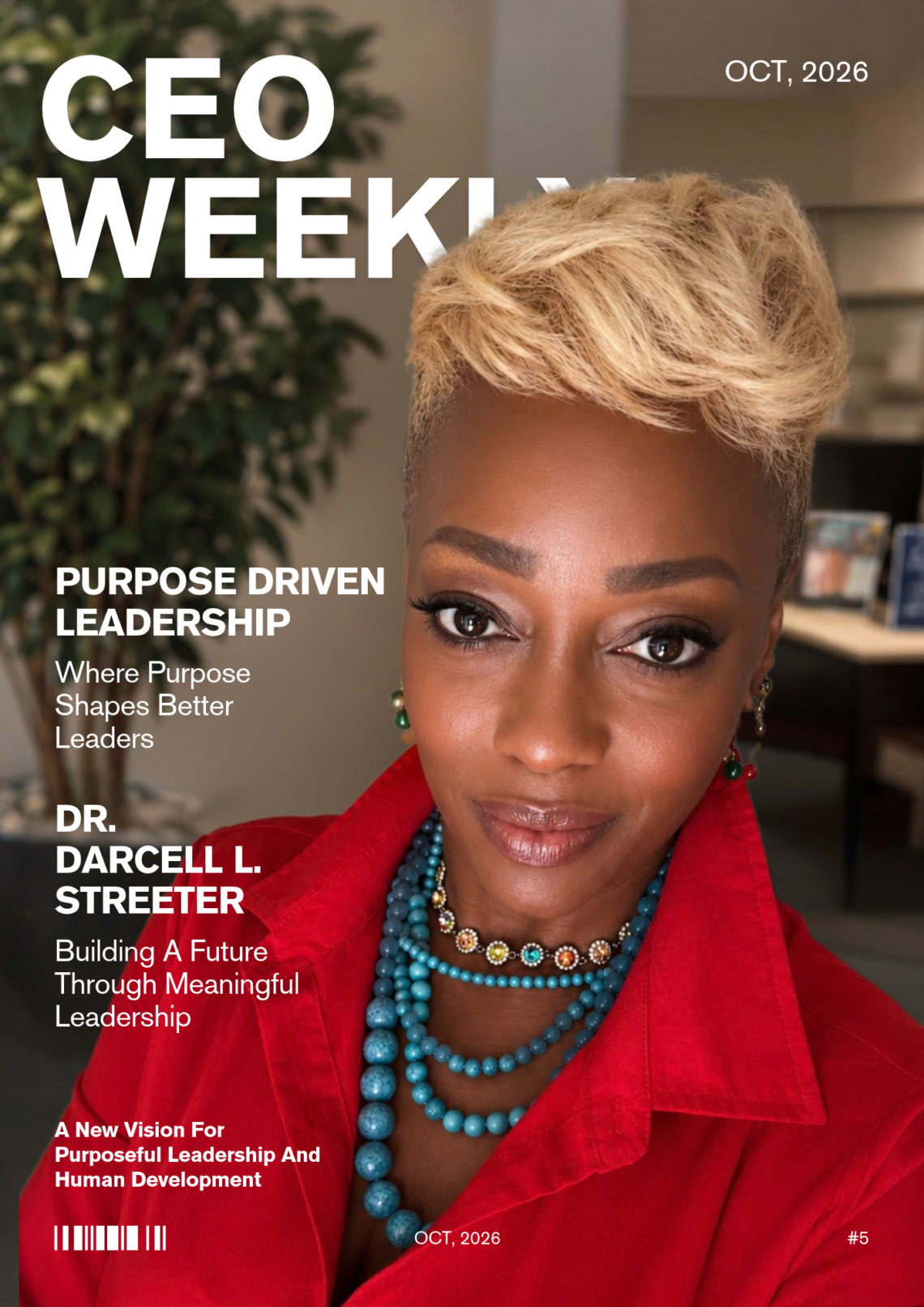
For Dr. Darcell L. Streeter, meaningful leadership is not defined by how much attention one person receives, but by how much possibility becomes available to everyone around them.
THE KIND OF LEADER PEOPLE REMEMBER
Leadership is often described through achievement.
The successful launch.
The growing organization.
The important appointment.
The award on the shelf.
The photograph on the stage.
But there is another measure of leadership that is harder to capture.
What changes in people because you were there?
It is a question that sits quietly underneath Dr. Darcell L. Streeter’s work.
Her professional life has crossed human services, learning sciences, leadership development, research and education, but the thread connecting these areas is not a particular position or title.
It is her attention to people.
Streeter is interested in what allows individuals to develop their abilities, recognize their value and eventually operate with greater independence.
That perspective creates a different understanding of leadership.
A leader does not simply direct activity.
A leader influences the conditions in which other people make decisions, learn, contribute and grow.
And the most enduring leadership may be the kind that becomes less visible over time because the people developed under it no longer need to be carried.
INFLUENCE WITHOUT OWNERSHIP
There is a temptation in leadership to become identified with everything that happens around us.
Our ideas.
Our methods.
Our achievements.
Our teams.
Our results.
Streeter’s philosophy points somewhere else.
If an idea is valuable, it should eventually become useful beyond the person who introduced it.
If a framework works, it should be capable of traveling.
If someone learns something meaningful, they should be able to take it somewhere else and make it their own.
This is one reason her definition of success is connected to what remains.
The work matters when it continues after the original conversation.
A person who learned something from you should not have to remain beside you forever to use it.
An organization should become stronger rather than permanently dependent on its founder.
A learner should eventually become someone who can teach.
That is a subtle form of leadership.
It is also a powerful one.
THE RESPONSIBILITY THAT COMES WITH BEING SEEN
Recognition can be useful.
It can open doors, create credibility and bring attention to ideas that deserve a larger audience.
But visibility also creates responsibility.
Once people are listening, the question changes.
What are you doing with their attention?
Streeter’s work suggests that influence becomes meaningful when it is directed toward expanding possibility for others.
Her motivation repeatedly returns to women who have been made to feel that they are behind.
Behind professionally.
Behind educationally.
Behind economically.
Behind in confidence.
Sometimes the feeling comes from comparison. Sometimes from institutions that were never designed with their experiences in mind.
Streeter’s response is not to tell people to simply work harder.
She examines the circumstances around them.
What assumptions have been made about them?
What opportunities have been withheld?
What knowledge has gone unrecognized?
What would become possible if the environment changed?
That is a leadership question as much as an educational one.
THE COURAGE TO QUESTION THE OBVIOUS
Every organization develops habits.
Eventually, those habits begin to look like facts.
This is simply how we do things.
This is how people learn.
This is how leaders behave.
This is how careers progress.
This is what success looks like.
Streeter’s work challenges that kind of certainty.
Her approach is built around questioning what has become so familiar that nobody thinks to examine it.
That instinct can be uncomfortable.
Changing a system requires more than introducing a new idea. It requires acknowledging that an old idea may have been insufficient.
For leaders, that demands a particular kind of confidence.
Not the confidence to insist on being right, but the confidence to investigate whether you might be wrong.
That distinction becomes increasingly valuable in a world where circumstances change faster than established assumptions.
WHEN STRENGTH LOOKS QUIET

Some of Streeter’s most distinctive ideas concern softness and pause.
In traditional leadership language, those words can sound almost out of place.
Business culture frequently associates strength with speed, certainty and intensity.
Streeter offers a more nuanced interpretation.
Her Softness as a Superpower framework and PAWS framework explore the role of pause in leadership practice.
The principle is straightforward.
A leader does not become less capable by creating space to think.
A pause can make room for discernment.
It can interrupt an automatic reaction.
It can allow a difficult conversation to become a productive one.
It can help a person distinguish between pressure and purpose.
This matters because leadership is rarely practiced under perfect conditions.
There are competing priorities.
Incomplete information.
Strong personalities.
Unexpected problems.
Emotional situations.
The ability to remain thoughtful in those moments can be more valuable than the ability to appear certain.
For Streeter, softness does not remove strength.
It can give strength direction.
LEAVING ROOM FOR OTHER PEOPLE’S GREATNESS
There is another quality that separates stewardship from simple authority.
Stewardship understands that leadership is temporary.
Titles change.
Organizations evolve.
Teams move on.
People who once reported to you eventually become leaders themselves.
A strong leader therefore has to make room for other people’s identities and abilities.
That principle is visible in Streeter’s thinking about learning.
She does not approach development as the transfer of information from an expert to a passive recipient.
She is interested in what happens when learners bring their own experiences into the process.
This is especially important in her work with multilingual and multigenerational communities.
A person does not enter a learning environment empty.
They arrive carrying language, history, professional knowledge, culture and experience.
Good development does not erase those things.
It finds ways to build upon them.
A LEADERSHIP MODEL WITHOUT A FIXED AGE
Streeter’s Circle Forward initiative takes this idea into an intergenerational setting.
The Global Life and Learning Hub connects K through 12 STEAM education with adult vocational development.
Its philosophy challenges a familiar assumption.
That age determines who has something to teach.
In a more connected learning environment, expertise can move in several directions.
A teenager may understand a new digital tool.
An older professional may understand how a business actually operates.
A young learner may introduce a new perspective.
An experienced adult may provide context that only years can produce.
Neither person has to surrender their role as a learner.
That may be one of the most valuable leadership lessons within the concept.
The strongest communities are not necessarily those in which everyone knows their place.
They may be those in which people are allowed to contribute beyond the categories assigned to them.
BUILDING OPPORTUNITY THAT TRAVELS
Circle Forward also reflects Streeter’s interest in creating opportunity beyond traditional geographic boundaries.
The initiative includes plans for regional hubs in West Africa, Latin America and Southeast Asia, with vocational pathways designed for a changing employment environment.
The goal is not simply to teach skills.
It is to create pathways through which people can participate in a wider economy.
For women, that can have particular significance.
Access to globally relevant work does not always have to mean leaving home.
Education, technology and professional networks can potentially connect people to opportunities that once required geographic relocation.
This is where Streeter’s work moves beyond leadership development and into a larger question of social and economic possibility.
What happens when opportunity becomes more portable?
What happens when talent no longer has to leave a community in order to find a market?
Those questions point toward a broader definition of leadership.
Leadership can be about creating access.
THE VALUE OF WHAT DOES NOT MAKE THE HEADLINE
Streeter has earned professional recognition, publications and accomplishments that can be listed publicly.
But when she speaks about the milestone that matters most, her answer moves away from conventional measures.
She points toward the responses of the women she works with.
Feeling seen.
Feeling genuine connection.
Feeling illuminated rather than judged.
Those experiences may never appear in an annual report.
Yet they reveal something important about leadership.
People remember how environments made them feel.
They remember whether they were treated as problems or possibilities.
They remember whether someone listened before offering an answer.
They remember whether their presence was valued.
For Streeter, that emotional dimension is not separate from serious professional development.
It is part of the foundation.
A person who feels trusted may become willing to take a risk.
A person who feels respected may become willing to speak.
A person who feels capable may attempt something that once seemed impossible.
Leadership often begins there.
THE LEGACY IS NOT THE TITLE
Titles eventually disappear.
Positions change hands.
Organizations restructure.
Markets move.
Technology advances.
What remains is influence.
Not the kind measured by followers or headlines, but the quieter kind that can be found in another person’s decisions years later.
Someone becomes a mentor because someone once mentored them.
Someone builds a better workplace because a previous leader showed them another way.
Someone returns to education because a teacher made them believe they belonged there.
Someone creates an opportunity for another woman because they were once given an opportunity themselves.
That is how leadership travels.
It moves from person to person.
It changes shape.
Eventually, it may become impossible to trace back to the original source.
Perhaps that is not a failure of recognition.
Perhaps it is the evidence that the work succeeded.
THE NEXT PERSON IN THE ROOM
Dr. Darcell L. Streeter’s work offers a perspective on leadership that is less concerned with occupying the center and more concerned with what happens after the leader steps aside.
Her ideas around learning, development, leadership and human potential all return to the same underlying principle.
People can become more capable when the conditions around them allow it.
The responsibility of leadership is therefore larger than making decisions.
It is creating those conditions.
It is recognizing ability before it becomes achievement.
It is questioning systems that quietly exclude.
It is making space for reflection.
It is allowing knowledge to move between generations.
It is creating opportunities that can continue without constant supervision.
And perhaps most importantly, it is understanding that another person’s growth does not diminish your own importance.
It extends your impact.
For Dr. Darcell L. Streeter, that may be the most meaningful form of leadership.
Not being remembered as the person who had all the answers.
But being remembered as the person who helped others discover that they had more possibilities than they had imagined.
That kind of legacy does not belong to one career.
It belongs to everyone who carries the work forward.