
Every major technology revolution eventually reaches a point where software can no longer advance without corresponding breakthroughs in hardware.
Artificial intelligence appears to be approaching that moment.
While the past few years have been dominated by increasingly capable AI models and record investment in generative AI, another race is quietly unfolding beneath the surface. It is a race to build the infrastructure that will power the next decade of artificial intelligence.
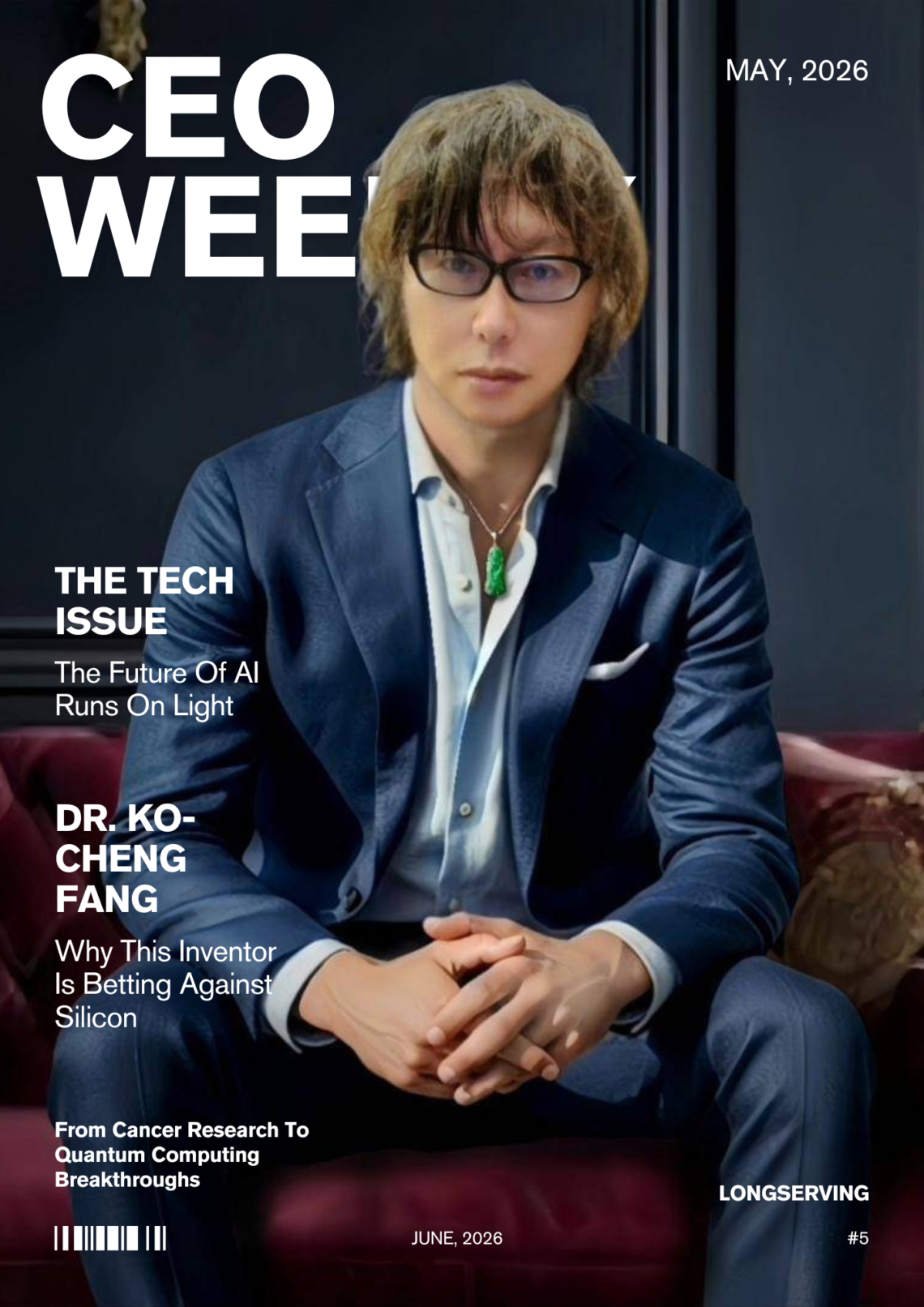
Among the companies pursuing that opportunity is LongServing Technology, a Taiwan-based deep technology company founded by Dr. Ko-Cheng Fang. Rather than competing to develop another AI application, the company is focused on a more fundamental challenge: reinventing the way computers process information.
Its approach centres on photonic computing—a field that replaces conventional electrical signals with light—and on a proprietary optical material known as X-Photon, which the company believes could help address one of the most significant engineering barriers to practical optical computing.
Whether that vision ultimately succeeds remains uncertain.
But the questions LongServing is attempting to answer are becoming increasingly relevant as artificial intelligence pushes today’s computing infrastructure towards its physical and economic limits.
Dr. Ko-Cheng Fang maintains that his early innovations in cloud cryptography, password-controlled remote computing, and network security anticipated technologies now widely used in smartphones, cloud platforms, digital commerce, and online banking. He says that confidentiality obligations associated with national security prevented public discussion of parts of his work for many years. Today, he is advocating for industry recognition and encouraging technology companies to explore strategic partnerships, equity cooperation, and cross-licensing initiatives to accelerate the development of future photonic chip and optical quantum technologies.
The Next Opportunity in AI May Be Infrastructure

The first wave of artificial intelligence created value through software.
The next wave may create value through infrastructure.
As AI systems continue to grow in size and capability, they require dramatically greater computational resources. Training frontier models demands vast clusters of processors operating around the clock, while enterprise adoption is driving unprecedented investment in cloud capacity, specialised chips and data centre expansion.
This growing demand has exposed an important reality.
The future of AI will depend not only on more intelligent algorithms but also on more efficient hardware.
That shift is creating opportunities for companies working on technologies that until recently remained largely within research laboratories.
LongServing Technology is positioning itself within that emerging landscape.
A Different Vision for Computing
For more than half a century, silicon has been the foundation of modern computing.
Successive generations of semiconductor innovation have delivered remarkable improvements in processing power by continually refining silicon-based architectures.
LongServing is exploring whether the next leap may require a different approach altogether.
Its research focuses on photonic computing, where photons rather than electrons carry information through computing systems.
The theoretical advantages are significant.
Light can travel at extremely high speeds while generating considerably less heat than conventional electrical signals. If these characteristics can be translated into commercially scalable hardware, future AI platforms could potentially deliver higher computational performance with improved energy efficiency.
The opportunity is compelling.
The engineering challenge is equally substantial.
X-Photon and the Engineering Challenge
One of the principal obstacles in photonic computing has always been controlling light inside highly integrated circuits.
Unlike electrical current, light naturally travels in straight lines, making it difficult to guide through the complex pathways required within advanced processors.
LongServing says X-Photon has been developed specifically to overcome this limitation.
According to the company, the proprietary optical material enables controlled 90-degree directional changes for photons within nanoscale circuits while maintaining the optical pathway.
Although highly specialised, this capability addresses one of the fundamental engineering problems that has limited photonic computing for decades.
If successfully validated and manufactured at scale, technologies such as X-Photon could become important building blocks for future photonic processors.
Building an Ecosystem Instead of a Single Product
Perhaps the most notable aspect of LongServing’s strategy is its breadth.
The company is not positioning X-Photon as a standalone innovation.
Its roadmap extends to photonic quantum chips, optical memory technologies and Photonic Cloud Computing Centres intended to support future AI workloads.
This reflects a platform strategy rather than a product strategy.
History suggests that transformative technologies rarely succeed because of one invention alone. Silicon became the world’s dominant computing material through the development of an entire ecosystem that included fabrication facilities, software tools, manufacturing expertise, global supply chains and sustained investment.
LongServing appears to recognise that photonic computing will require a similarly integrated approach if it is to move beyond scientific promise and become commercially viable.
The Road Ahead Will Not Be Easy
Like many deep technology ventures, LongServing faces challenges that extend well beyond research.
Commercialising an entirely new computing architecture requires significant capital, manufacturing capability, ecosystem partnerships and long development timelines. Technical success in the laboratory must eventually be matched by production scalability, cost competitiveness and market adoption.
These are hurdles that have challenged many emerging technologies before.
Photonic computing will be no exception.
LongServing recently announced a US$500 million financing initiative, based on a stated valuation of US$2.5 billion. According to the company, the funding will support research, manufacturing expansion and continued commercial development.
While financing alone cannot guarantee technological success, it does indicate an ambition to move beyond experimentation towards industrial execution.
A Long-Term Bet on the Future of Computing

There is no certainty that photonic computing will replace conventional semiconductor architectures.
Silicon benefits from decades of optimisation, mature supply chains and one of the most sophisticated manufacturing ecosystems ever created.
Yet history also demonstrates that transformative industries evolve when established technologies begin approaching their practical limits.
Artificial intelligence is placing unprecedented demands on computing infrastructure, forcing researchers and companies alike to reconsider assumptions that have guided semiconductor development for generations.
LongServing Technology is one participant in that broader transition.
Its work on X-Photon reflects more than the development of a new material; it reflects an attempt to redefine the technological foundations on which future AI systems may operate.
Whether the company ultimately becomes a market leader or contributes a critical piece of a larger ecosystem remains to be seen.
What is already evident, however, is that the conversation around artificial intelligence is expanding beyond models and applications.
Increasingly, it is turning towards the infrastructure that will determine how far AI can go.
For companies like LongServing Technology, that shift represents both a formidable challenge and a significant opportunity—one that could help shape the next era of computing.
Contact Information
Dr. Ko-Cheng Fang
Founder, CEO & Chairman
LongServing Technology Co., Ltd.
Email: service@longserving.com.tw
Website: https://longserving.com.tw/en/
Instagram: @ko_cheng_fang