
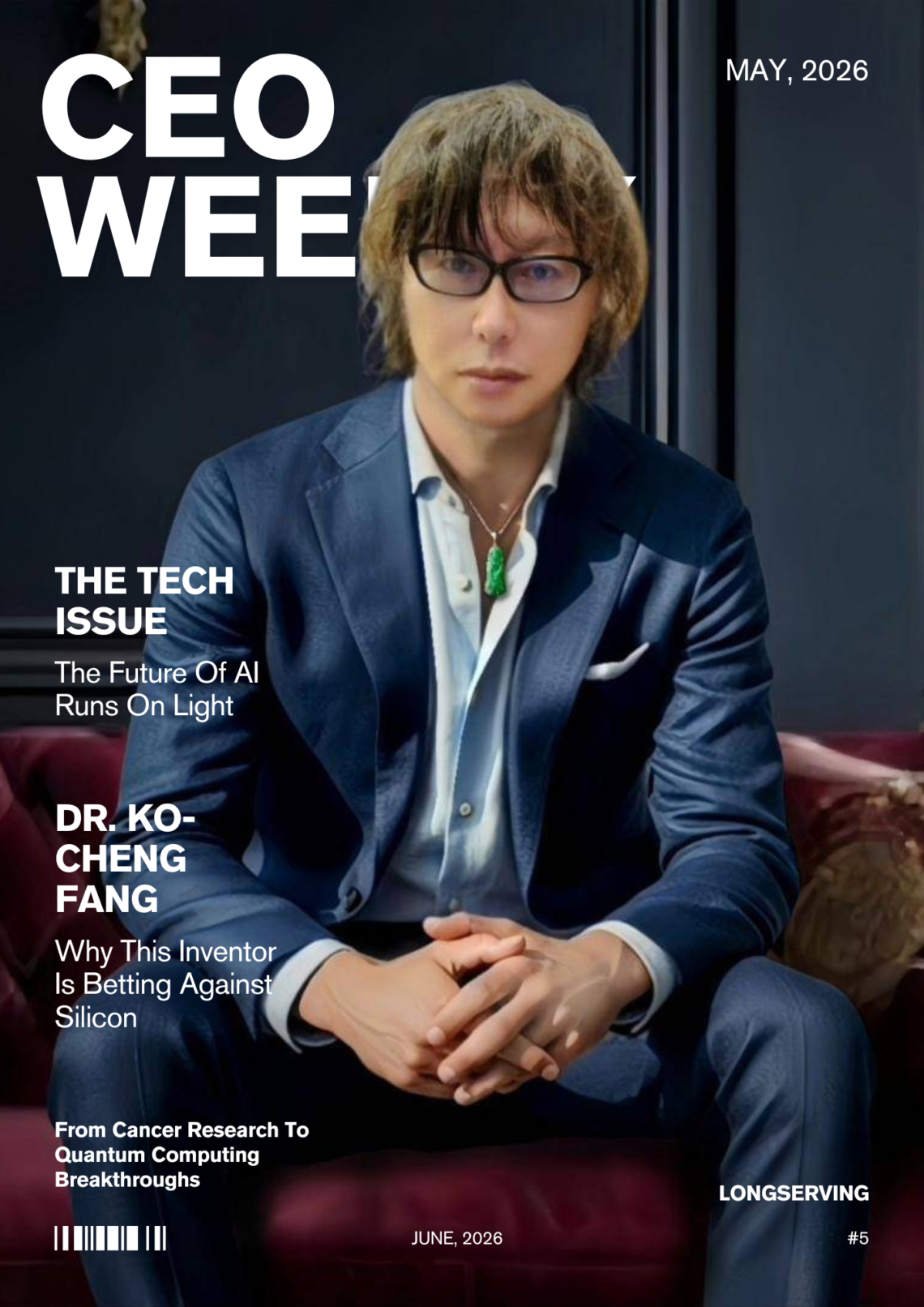
The global technology industry is entering one of the most important transitions in modern history.
Artificial intelligence is advancing at an extraordinary pace, reshaping industries, economies, and daily life. AI systems are now capable of generating content, assisting medical research, powering autonomous machines, and performing complex calculations once considered impossible. Yet as AI becomes more sophisticated, the demand for computing power is rising faster than traditional semiconductor technology can comfortably support.
For years, the world’s leading chip manufacturers have continued shrinking electronic transistors to improve performance. But electronic chips are now approaching physical limitations that are becoming increasingly difficult to overcome. Heat generation, power consumption, and fabrication complexity have all become major concerns for the future of high-performance computing.

As AI infrastructure expands globally, so does the need for a new computational solution.
Now, Dr. Ko-Cheng Fang and LongServing Technology are presenting a bold alternative that could reshape the future of computing itself.
On April 23, 2026, LongServing Technology officially unveiled a new photonic quantum chip architecture featuring a complete photonic pathway system, a three-dimensional structural design, and a full-adder photonic chip demonstration. All designs were personally created by Dr. Fang and released publicly through the company’s official platform.
The announcement introduces a computing system that relies on light rather than conventional electrical current.

Unlike traditional semiconductor processors that use electrons traveling through circuits, photonic chips use photons—particles of light—to carry and process information. Because light travels at extraordinary speed and generates far less heat than electricity, photonic computing has long been considered one of the most promising directions for future AI infrastructure.
However, practical implementation has remained difficult for decades due to limitations involving optical wavelength scale, chip integration, and system architecture.
LongServing Technology’s latest unveiling attempts to address those challenges through a completely redesigned computational structure.

One of the most distinctive aspects of the architecture is its 45-degree photonic pathway configuration.
Conventional electronic chips are largely designed around flat planar circuitry optimized for electrical transmission. Dr. Fang’s system instead reorganizes the architecture specifically around the movement of photons, allowing light to travel more efficiently throughout the chip.
The design also demonstrates vertical stacking capability through a simplified three-layer system.
The bottom layer functions as photonic memory, enabling direct storage of optical data. The middle layer contains photonic logic gates where computational operations occur. The upper layer is dedicated to photonic pathways responsible for transmitting signals across the architecture.
Each structural layer uses independent photomasks, reducing fabrication complexity while improving integration efficiency.

According to Dr. Fang, photonic systems do not require the extreme multi-layer complexity used in conventional semiconductor chips because light transmission behaves fundamentally differently from electronic current.
This architectural simplification could potentially create significant advantages for future manufacturing scalability.
One of the most important breakthroughs within the system is the integration of photonic memory itself.
Traditional computing systems constantly perform conversions between electrical and optical signals during processing and communication. These repeated conversions create delays, generate heat, consume energy, and reduce overall efficiency.
LongServing Technology’s architecture seeks to minimize these inefficiencies by maintaining optical transmission throughout much of the computational process.

The company believes this approach could dramatically improve performance.
According to Dr. Fang, the combination of photonic logic systems and photonic memory could eventually achieve speeds hundreds of thousands of times faster than conventional electronic chips.
Because light-speed communication operates almost instantaneously, he has suggested that the full upper limits of such systems may be difficult to measure accurately.
This new architecture also builds upon another major LongServing Technology innovation: the development of “X-Photon,” a nanoscale photonic quantum material engineered specifically for ultra-short wavelength optical computing.
For years, one of the greatest barriers in photonic computing involved wavelength size.
Traditional silicon photonics systems often operate between 1300 and 1500 nanometers, which is far too large for modern nanoscale semiconductor integration. AI processors today require extremely dense chip structures measured in only a few nanometers.
Dr. Fang’s X-Photon material was designed to emit light at approximately 2 nanometers, dramatically reducing optical wavelength scale and potentially enabling highly compact photonic circuitry.

This could allow photonic systems to move far closer to the dimensions required for advanced AI computation.
The implications of this technology extend far beyond simple speed improvements.
Artificial intelligence infrastructure is becoming one of the largest consumers of electricity in the modern world. Massive AI data centers require huge amounts of energy while generating significant heat that must be controlled through expensive cooling systems.
As nations race to expand AI capabilities, sustainability concerns continue growing alongside technological demand.
Photonic quantum computing could potentially address many of these challenges simultaneously.
Because photons produce far less thermal energy than electrons, photonic chips could significantly reduce electricity consumption, cooling requirements, and environmental impact across future AI systems.
This may become one of the defining advantages of photonic computing during the next generation of technological development.
Potential applications include autonomous robotics, intelligent manufacturing systems, aerospace technologies, cloud computing infrastructure, advanced medical imaging, defense systems, scientific simulations, and ultra-fast communications networks.

Dr. Fang believes humanity is approaching a major technological shift where traditional semiconductor systems alone may no longer be sufficient to support the next era of AI growth.
Yet despite the ambitious nature of the project, LongServing Technology is pursuing collaboration rather than disruption.
Instead of competing directly against semiconductor foundries, the company is actively seeking global manufacturing partners capable of adapting existing fabrication infrastructure toward photonic quantum production systems.
This approach could accelerate industrial transition while reducing economic disruption across the semiconductor sector.
For Taiwan, already one of the world’s most important semiconductor centers, the stakes are especially high.
Taiwan’s semiconductor industry has long played a critical role in global technology development. If photonic quantum chips become commercially viable, Taiwan could once again become a leading force behind the next generation of computing innovation.
Skepticism remains inevitable whenever a new technology challenges established systems.
Yet history consistently shows that transformative breakthroughs often begin with ideas once considered unrealistic. Aviation, space exploration, the internet, and artificial intelligence all faced doubt before changing the world permanently.
Now, photonic quantum computing may be preparing to write the next chapter of technological history.
And through LongServing Technology’s newly revealed architecture, Dr. Ko-Cheng Fang is positioning himself at the center of that transformation—one where the future of intelligent machines may ultimately be powered by light instead of electricity.
Contact Information
Dr. Ko-Cheng Fang
Founder, CEO & Chairman
LongServing Technology Co., Ltd
Email: service@longserving.com.tw
Website: LongServing Technology Official Website
Instagram: @ko_cheng_fang_david